Why Should People Use Lucy Caukins Reading
Early on reading teachers and researchers are reacting with surprise, frustration, and optimism later the Teachers College Reading and Writing Project, the organization that designs one of the almost pop reading programs in the country, outlined a new arroyo to teaching children how to read.
A document circulated at the group's professional development events, first reported on by APM Reports on Friday, calls for increased focus on ensuring children can recognize the sounds in spoken words and link those sounds to written letters—the foundational skills of reading. And it emphasizes that sounding out words is the best strategy for kids to use to figure out what those words say.
"[P]oring over the piece of work of gimmicky reading researchers has led us to believe that aspects of balanced literacy need some 'rebalancing,'" the document reads.
While the certificate suggests that these ideas about how to teach reading are new and the product of recent studies, they're in fact part of a long-established trunk of settled science. Decades of cognitive science enquiry has shown that providing children with explicit teaching in speech sounds and their correspondence to written messages is the most effective fashion to make sure they learn how to read words.
Just it's significant to see these ideas coming from the Teachers College Reading and Writing Project. The plan, founded past Lucy Calkins and housed at Columbia University, has long downplayed the importance of these foundational skills in early on reading instruction, and has pushed other, disproven strategies for identifying words.
In a argument to Education Week, Calkins said that the certificate reflects work they have done with researchers at the Child Mind Constitute, a nonprofit that supports children with mental wellness and learning disorders.
"Those who know us well, know that we are a university-based learning community, and that the knowledge nosotros offer is constantly evolving and expanding. The document reflects my strong conventionalities that children will benefit when people with diverse perspectives and backgrounds sit at the same table and mind advisedly to each other," Calkins wrote.
Calkins also noted that the certificate has been shared at dozens of TCRWP events, including a virtual reunion for teachers this by weekend.
Mixed Signals on Cueing
The Units of Study for Teaching Reading, the TCRWP curriculum for reading educational activity in grades G-5, is i of the biggest players in the early reading market. A 2019 Education Week Research Center survey establish that 16 percent of K-two and special education teachers apply the Units of Report to teach reading.
But as APM Reports noted, the curriculum has faced increased scrutiny, including from reading researchers. Some states and districts have reconsidered its utilize.
The curriculum doesn't include systematic, explicit teaching in phonemic awareness or phonics in the early on grades, every bit Educational activity Week has reported. The visitor started publishing a supplemental phonics program in 2018, but marketing materials for the new units imply that phonics shouldn't play a primal role in the early years classroom. "Phonics instruction needs to be lean and efficient," the materials read. "Every minute you lot spend teaching phonics (or preparing phonics materials to utilize in your lessons) is less time spent teaching other things."
But it'southward non only that the materials sideline phonemic awareness and phonics—they besides teach reading strategies that tin can arrive harder for students to learn these skills.
Calkins' materials promote a strategy called "three-cueing," which suggests that students tin decipher what words say by relying on three different sources of data, or cues. They can look at the letters, using a "visual" cue. Simply they tin also rely on the context or syntax of a sentence to predict which give-and-take would fit, the theory goes. Reading researchers and educators say that this can lead to students guessing: making up words based on pictures, or what'due south happening in the story, rather than reading the words by attention to the messages.
This new document seems to signal a major change in instructional theory from the system.
Information technology emphasizes the importance of foundational skills, recommending that students in kindergarten and the autumn of 1st form receive daily instruction in phonemic awareness, and saying that all early readers could benefit from frequent phonics practice. It recommends decodable books—those with a high proportion of letter of the alphabet-sound correspondences that students have already learned—be a function of immature children's "reading diets." And information technology suggests regular assessments of phonemic awareness, as problems in that area tin indicate reading difficulties.
Peculiarly notable, the document seems to practise an changeabout on cueing. Students should non exist "speculating what the give-and-take might say based on the motion picture," the document reads. Instead, teachers should tell children to "respond to catchy words by showtime reading through the word, audio-by-audio, (or role by part) and only then, afterwards producing a possible pronunciation, check that what she's produced makes sense given the context," information technology reads.
The statement on cueing contradicts advice Calkins was giving less than a year agone. In November 2019, Calkins released a argument pushing back on those whom she called, "the phonics-centric people who are calling themselves 'the science of reading.'"
In that statement last year, Calkins said teachers shouldn't encourage students to guess at words. Just she did say that students could create a hypothesis based on the context of the sentence.
In a response to Calkins' statement, reading researcher Mark Seidenberg wrote at the time, "Dr. Calkins says she disdains iii-cueing, just the method is correct there in her document."
Teachers Need 'Fine-Grained Guidance'
The past couple of years have marked an development of publishers' and reading organizations' public positions on reading scientific discipline and how information technology should guide instruction, spurred in large function by media coverage of best practice from Emily Hanford of APM Reports, and other outlets, including Education Week.
In July of terminal yr, for example, the International Literacy Association published a brief emphasizing the importance of systematic, explicit phonics instruction, a articulate stardom of stance from an organization that has long included members on opposing sides of the "reading wars."
Merely it's not a given that any of Calkins' or TCRWP's statements volition change classroom practice, said Julia Kaufman, a senior policy researcher at the RAND Corporation, who studies how school systems tin can support high-quality instruction. Past enquiry from RAND has also constitute that Calkins' materials are widely used in U.S. schools.
"I don't think there'southward any style that we can expect a shift in [TCRWP's] philosophy and ideas to alter anything unless information technology's documented and actually articulate to teachers where they need to alter," she said.
Curriculum and implementation is complex, Kaufman added: "Teachers demand specific and detailed and fine-grained guidance in gild to know what they need to practise in the classroom."
In their reporting on this recent document, APM Reports noted that educators at a recent TCRWP grooming received supplemental curriculum materials that encouraged decoding.
The core curriculum, though, still promotes cueing. For instance, a strategies chart from a sample 1st grade lesson tells students to "Think about what'southward happening," "Check the movie," and "Think about what kind of give-and-take would fit," as means to solve hard words.
Unless and until TCRWP puts out a new edition of the Units of Study for Instruction Reading, with detailed instructor guidance that reflects these philosophical shifts, Kaufman said she wouldn't expect to see much modify in unproblematic classrooms.
Some educators were optimistic that TCRWP'due south new position could lead to more than widespread adoption of show-based pedagogy and college reading achievement. "Lots of changes even so to make just this is encouraging!" wrote Erin Beard, a literacy coach, on Twitter.
Others expressed frustration over a motion they saw as also piffling, too late.
"Is she handing out refunds for all the intervention needed for the missed learning opportunity?" LaTonya M. Goffney, the superintendent of Aldine Independent School District, wrote on Twitter. "Our most vulnerable students - black, brown, poor, ELL, & special education students paid the ultimate price!"
Sharon Contreras, the superintendent of Guilford County schools, noted that whatever changes would likely come up at a cost for districts using Calkins' materials.
"Millions of dollars wasted. Thousands of students cannot read proficiently. Districts spending a small fortune on new curriculum & to retrain teachers. All totally avoidable," she wrote, on Twitter.
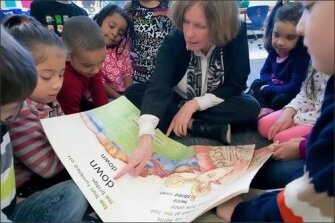
Image: Lucy Calkins —Peter Cunningham-File

A version of this news article first appeared in the Teaching At present blog.
A version of this article appeared in the October 28, 2020 edition of Education Week every bit Lucy Calkins Says Balanced Literacy Needs 'Rebalancing'
Source: https://www.edweek.org/teaching-learning/lucy-calkins-says-balanced-literacy-needs-rebalancing/2020/10
Post a Comment for "Why Should People Use Lucy Caukins Reading"