Pathologic and Radiologic Correlation of Adult Cystic Lung Disease- a Comprehensive Review
This article has been cited by other manufactures in ScienceCentral.
Abstract
Groundwork
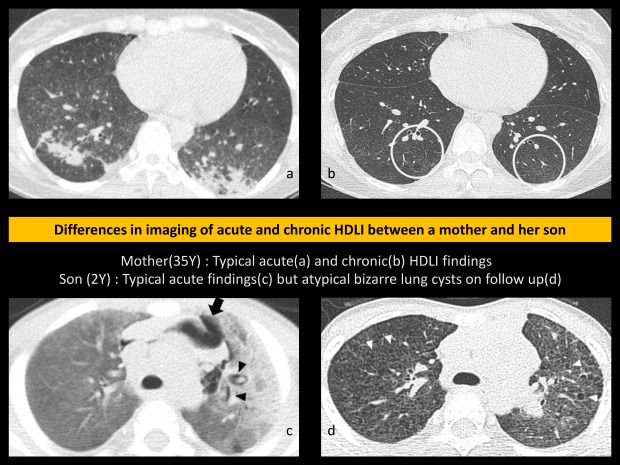
To compare the breast computed tomography (CT) images of children and adults in families with clusters of humidifier disinfectant-related lung injury (HDLI) subsequently cessation of exposure to humidifier disinfectant (Hard disk).
Methods
We reviewed medical records of nineteen families with 43 patients (21 adults, 22 children) amid families, which had at least one adult and one child with HDLI. Each family was exposed to the same Hard disk exposure environment.
Results
In adults, centrilobular nodules were predominant (95.2%) in chronic HDLI findings after cessation of exposure to Hard disk drive, all the same, in children, normal pattern was virtually prevalent on chest CT (45.5%), followed by centrilobular nodule (36.four%), baroque lung cysts (36.4%), and reticulation (13.half-dozen%).
Decision
Different the known chronic HDLI finding of adults, centrilobular nodules were merely nowadays in 36.4% of children. The frequency of bizarre lung cysts were significantly greater in children than that in adults later on abeyance of similar exposure to HD. Thus, bizarre lung cysts may be useful as another novel finding of chronic HDLI in children who have no history of pulmonary infection or other perinatal disorder such as hyaline membrane disease or other interstitial lung illness.
Graphical Abstract
INTRODUCTION
Humidifier disinfectant-related lung injury (HDLI) is a severe course of lung impairment that just occurred in Korean individuals who were exposed to a specific humidifier disinfectant (HD). The antimicrobial biocide, polyhexamethylene guanidine phosphate, was the causative ingredient in the commercial product, and Korea banned this production in 2011. Previous study described that the symptoms of HDLI are cough, dyspnea, and occasionally fever, and the progression may exist subacute or rapid, similar to acute respiratory distress syndrome (ARDS).12
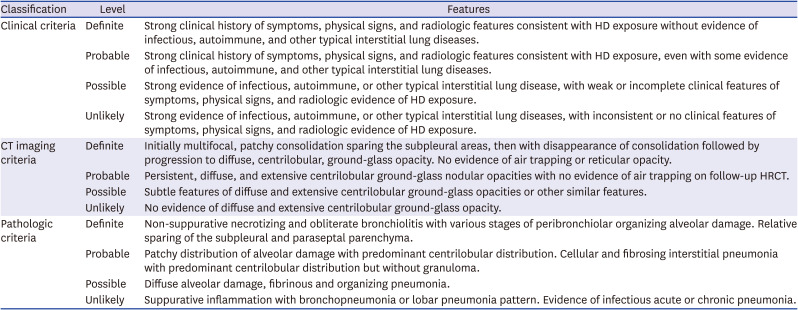
The chest multidetector computed tomography (MDCT) images indicated that HDLI is characterized by lengthened centrilobular footing-drinking glass opacity and nodules, which spare the subpleural spaces. There are frequently spontaneous air leaks, such as a pneumothorax or pneumomediastinum, but no evidence of air trapping or reticular opacity. The histopathologic features typically include bronchocentric distribution of fibroinflammatory lesions, which become more pronounced over time. Epidemiological studies indicated that HDLI onset was by and large during dry seasons (when humidifiers are well-nigh used) and amassed within families.345678 Analysis of the pathologic, radiologic, and clinical features of HDLI cases and the lung histopathology of HD-exposed experimental animals led to refinement of the diagnostic criteria for HDLI in 2013 (Table 1).69 The first three rounds of our investigation, conducted from July 2013 to December 2015, establish that 38% (n = 453) of 1,196 individuals who claimed that Hard disk drive exposure was related to their diseases had confirmed HDLI. Among them, children nether eight years-old accounted for 62% of cases, and pregnant women accounted for 7% of cases.11
Table ane
Diagnostic criteria for HDLI6
| Classification | Level | Features |
|---|---|---|
| Clinical criteria | Definite | Potent clinical history of symptoms, physical signs, and radiologic features consistent with Hd exposure without show of infectious, autoimmune, and other typical interstitial lung diseases. |
| Likely | Stiff clinical history of symptoms, concrete signs, and radiologic features consistent with Hard disk drive exposure, fifty-fifty with some evidence of infectious, autoimmune, and other typical interstitial lung diseases. | |
| Possible | Strong evidence of infectious, autoimmune, or other typical interstitial lung disease, with weak or incomplete clinical features of symptoms, physical signs, and radiologic bear witness of Hard disk drive exposure. | |
| Unlikely | Strong bear witness of infectious, autoimmune, or other typical interstitial lung diseases, with inconsistent or no clinical features of symptoms, physical signs, and radiologic evidence of HD exposure. | |
| CT imaging criteria | Definite | Initially multifocal, patchy consolidation sparing the subpleural areas, then with disappearance of consolidation followed by progression to lengthened, centrilobular, footing-glass opacity. No prove of air trapping or reticular opacity. |
| Likely | Persistent, diffuse, and extensive centrilobular ground-glass nodular opacities with no evidence of air trapping on follow-upwards HRCT. | |
| Possible | Subtle features of diffuse and extensive centrilobular ground-glass opacities or other similar features. | |
| Unlikely | No evidence of diffuse and extensive centrilobular ground-glass opacity. | |
| Pathologic criteria | Definite | Non-suppurative necrotizing and obliterate bronchiolitis with diverse stages of peribronchiolar organizing alveolar damage. Relative sparing of the subpleural and paraseptal parenchyma. |
| Likely | Patchy distribution of alveolar damage with predominant centrilobular distribution. Cellular and fibrosing interstitial pneumonia with predominant centrilobular distribution but without granuloma. | |
| Possible | Diffuse alveolar impairment, fibrinous and organizing pneumonia. | |
| Unlikely | Suppurative inflammation with bronchopneumonia or lobar pneumonia pattern. Bear witness of infectious acute or chronic pneumonia. |
Centrilobular distribution and subpleural sparing are the main pathologies of HDLI.2 Subpleural sparing is considered in the differential diagnosis of HDLI, idiopathic pulmonary fibrosis, and ARDS. Furthermore, HDLI is characterized by radiological changes over time. It begins with areas of patchy consolidation involving the upper lung periphery and posterior lower lung zones, merely sparing the subpleural areas. These areas evolve into centrilobular opacities, and the consolidation disappears virtually 5 years subsequently the cessation of Hard disk drive exposure.912 Notwithstanding, there are limited radiological long-term follow-up information of patients with advanced HDLI.2912 In particular, little is known near radiological differences betwixt children and adults long after cessation of exposure to Hard disk.
Thus, we aimed to compare chest computed tomography (CT) images of children and adults in families with clusters of HDLI long afterward cessation of exposure to HD.
METHODS
Data were from the Korea Environmental Industry & Technology Institute, which officially collected data on individuals with lung disease, each of whom claimed that the illness was related to apply of Hard disk. Each registered claimant was clinically examined for diagnosis and confirmation of HDLI. The combination of clinical manifestations, natural disease course, exposure to HD, and radiological and pathological findings were used for confirmation.
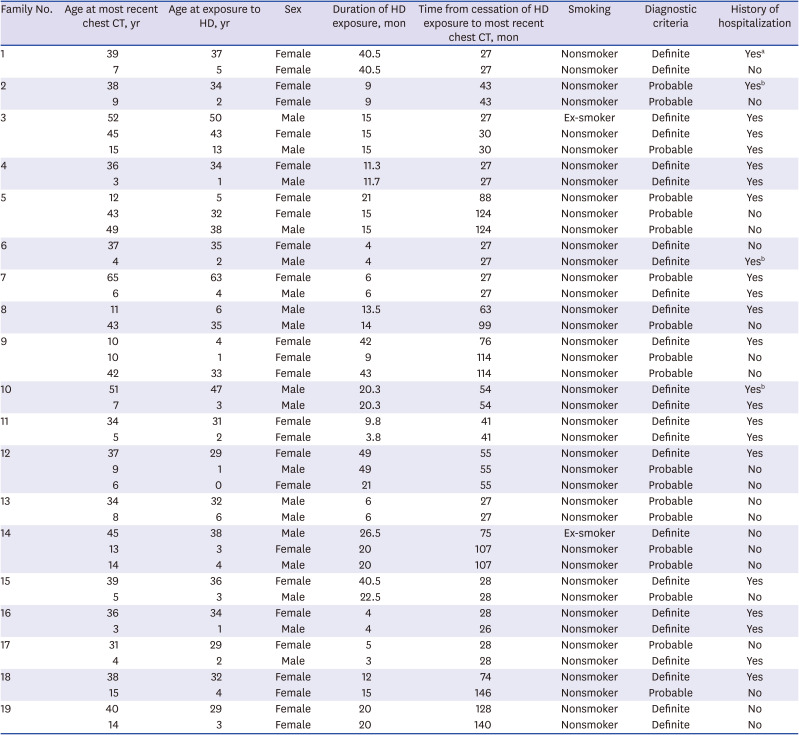
A full of 1,196 individuals from 748 families claimed that HD exposure was related to their diseases during the get-go iii rounds of investigations (July 2013 to December 2015). The medical records and exposure histories of families that had at least two patients with definite or probable HDLI ("confirmed HDLI") were identified (200 individuals from 64 families). Then, families were selected for the present study if they had both children and adults among the confirmed HDLI patients. Finally, 19 families with 43 patients (21 adults, 22 children) were analyzed. Each included family had at to the lowest degree i developed and one child with HDLI. Xiv families (28 patients) had one adult and 1 child; ii families (half-dozen patients) had two adults and ane child; and three families (9 patients) had one developed and two children. The age, sex, history of smoking, duration of using Hard disk drive exposure, history of hospitalization and clinical course during acute HDLI menstruation, chest CT taken during acute and chronic HDLI catamenia, and fourth dimension from cessation of Hard disk exposure to chest CT examination was recorded for each of the 43 patients (Tabular array ii).
Table 2
General characteristics of patients with chronic HDLI (n = 43)
| Family No. | Age at nigh recent chest CT, yr | Age at exposure to Hard disk drive, yr | Sex activity | Duration of Hard disk drive exposure, mon | Time from abeyance of HD exposure to most contempo chest CT, mon | Smoking | Diagnostic criteria | History of hospitalization |
|---|---|---|---|---|---|---|---|---|
| 1 | 39 | 37 | Female | 40.5 | 27 | Nonsmoker | Definite | Yepa |
| 7 | 5 | Female | twoscore.5 | 27 | Nonsmoker | Definite | No | |
| two | 38 | 34 | Female | 9 | 43 | Nonsmoker | Probable | Yesb |
| 9 | 2 | Female | 9 | 43 | Nonsmoker | Probable | No | |
| iii | 52 | 50 | Male | xv | 27 | Ex-smoker | Definite | Yes |
| 45 | 43 | Female | 15 | 30 | Nonsmoker | Definite | Aye | |
| xv | 13 | Male person | 15 | 30 | Nonsmoker | Likely | Aye | |
| 4 | 36 | 34 | Female | xi.3 | 27 | Nonsmoker | Definite | Yes |
| three | 1 | Male person | eleven.7 | 27 | Nonsmoker | Definite | Yeah | |
| 5 | 12 | 5 | Female | 21 | 88 | Nonsmoker | Probable | Yes |
| 43 | 32 | Female | xv | 124 | Nonsmoker | Probable | No | |
| 49 | 38 | Male person | fifteen | 124 | Nonsmoker | Probable | No | |
| 6 | 37 | 35 | Female | 4 | 27 | Nonsmoker | Definite | No |
| 4 | 2 | Male | 4 | 27 | Nonsmoker | Definite | Yesb | |
| 7 | 65 | 63 | Female | vi | 27 | Nonsmoker | Probable | Yes |
| half dozen | 4 | Male | 6 | 27 | Nonsmoker | Definite | Yes | |
| 8 | 11 | 6 | Male person | 13.5 | 63 | Nonsmoker | Definite | Yes |
| 43 | 35 | Male | 14 | 99 | Nonsmoker | Likely | No | |
| 9 | 10 | 4 | Female | 42 | 76 | Nonsmoker | Definite | Yes |
| 10 | i | Female person | 9 | 114 | Nonsmoker | Likely | No | |
| 42 | 33 | Female | 43 | 114 | Nonsmoker | Probable | No | |
| 10 | 51 | 47 | Male | twenty.3 | 54 | Nonsmoker | Definite | Yepb |
| 7 | 3 | Male | 20.3 | 54 | Nonsmoker | Definite | Yeah | |
| eleven | 34 | 31 | Female | 9.8 | 41 | Nonsmoker | Definite | Aye |
| 5 | 2 | Female | 3.8 | 41 | Nonsmoker | Definite | Aye | |
| 12 | 37 | 29 | Female person | 49 | 55 | Nonsmoker | Definite | Yes |
| 9 | 1 | Male person | 49 | 55 | Nonsmoker | Probable | No | |
| 6 | 0 | Female | 21 | 55 | Nonsmoker | Likely | No | |
| 13 | 34 | 32 | Male person | 6 | 27 | Nonsmoker | Likely | No |
| 8 | 6 | Male | 6 | 27 | Nonsmoker | Probable | No | |
| 14 | 45 | 38 | Male | 26.v | 75 | Ex-smoker | Definite | No |
| 13 | three | Female | 20 | 107 | Nonsmoker | Likely | No | |
| xiv | four | Male person | 20 | 107 | Nonsmoker | Probable | No | |
| fifteen | 39 | 36 | Female | 40.5 | 28 | Nonsmoker | Definite | Yes |
| 5 | three | Male | 22.5 | 28 | Nonsmoker | Probable | No | |
| 16 | 36 | 34 | Female person | 4 | 28 | Nonsmoker | Definite | Yes |
| iii | 1 | Male | 4 | 26 | Nonsmoker | Definite | Aye | |
| 17 | 31 | 29 | Female | five | 28 | Nonsmoker | Probable | No |
| 4 | ii | Male person | iii | 28 | Nonsmoker | Definite | Aye | |
| xviii | 38 | 32 | Female | 12 | 74 | Nonsmoker | Definite | Yes |
| 15 | 4 | Female | 15 | 146 | Nonsmoker | Probable | No | |
| 19 | 40 | 29 | Female person | xx | 128 | Nonsmoker | Definite | No |
| 14 | 3 | Female | 20 | 140 | Nonsmoker | Definite | No |
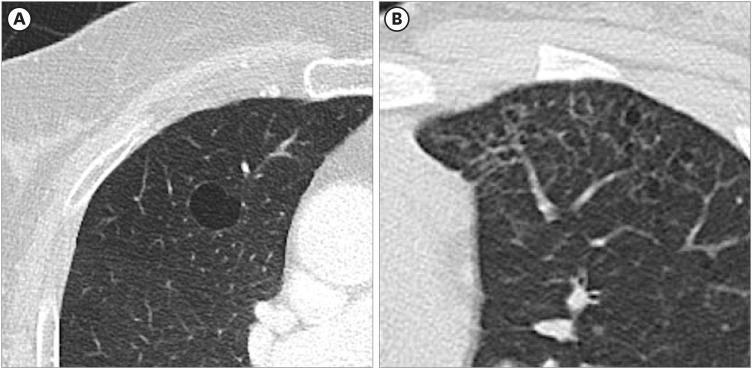
Each patient received breast CT examination at different hospitals in Korea for evaluation of the lung manifestations of HDLI. Various MDCT scanners were used for this study, for case, 16 aqueduct MDCT (Somatom Sensation xvi; Siemens Healthcare, Erlangen, Frg), 64 aqueduct MDCT (Aquillion 64; Toshiba, Tokyo, Japan) or 128 channel multidetector CT (Somatom Definition Flash; Siemens Healthcare). Tube voltage between 80–120 kVp, 100–120 effective mAs with dose modulation were used. All exams included a loftier-resolution axial image with a thickness of less than 2 mm, and analysis at a window width of 1,500 HU and a window level of −600 HU. Two chest radiologists with v and 16 years of experience evaluated CT results in consensus. They classified breast CT findings during acute HDLI period equally consolidation, subpleural sparing, ground-glass opacity, and air leak. Follow-up CT findings were classified as normal, centrilobular nodule, parenchymal baloney, reticulation, and air trapping based on the guidelines of the Fleischner Society.13 In our cases, multiple cystic parenchymal lucency were found in children, with irregular and bizarre in shape. The Fleischner Order described lung cyst as a round parenchymal lucency with a well-defined interface with normal lung.thirteen So we categorized those finding equally bizarre lung cysts and included them in the assay (Fig. ane).
Fig. ane
Comparison of the shape of archetype lung cyst and baroque lung cyst. (A) The Fleischner Society described lung cyst equally a round parenchymal lucency with a well-defined interface with normal lung. (B) A 11 years old girl with baroque lung cysts (family No.nineteen). Variable shaped lung cysts and relatively well-defined interface with normal lung.
Statistical analysis was performed using IBM SPSS version 21.0 (IBM Corp., Armonk, NY, The states). The demographic characteristics of all patients are presented, and a Fisher's verbal exam was used to compare differences between adults and children.
Ethics statement
Subsequently receiving an explanation of the survey, all participants provided written informed consent for participation. This survey was canonical past the Institutional Review Board of the National Institute of Environmental Enquiry (NIER-2018-04-02-075).
RESULTS
We enrolled 19 families with 21 adults (vi men and xv women) and 22 children (12 boys and ten girls), 4 of whom were exposed to HD during gestation (Tables three and iv). The overall hateful elapsing of Hard disk exposure was 17.6 ± 13.1 months (17.0 ± xiii.i months in adults and xv.9 ± 11.9 months in children). The mean duration from cessation of exposure to Hd to the latest CT exam was 55.four months (duration: 27–128 months) for adults and 58.5 months (duration: 27–146 months) for children. All 22 children had no prior hospitalization for congenital or perinatal menses disorder, or lung-related illness such as pneumonia or bronchiolitis.
Table 3
Chest CT findings of adults and children during acute HDLI menses

| Chest CT findings | Acute HDLI flow (n = 21) | ||
|---|---|---|---|
| Full (n = 21) | Adults (n = 11) | Children (n = 10) | |
| Consolidation | 17 (eighty.9) | 9 (81.8) | 8 (80.0) |
| Ground-drinking glass opacity | 19 (xc.5) | ten (90.nine) | 9 (90.0) |
| Subpleural sparing | 21 (100.0) | 11 (100.0) | x (100.0) |
| Air leaka,b | 9 (42.9) | ii (18.two) | 7 (70.0) |
Table 4
Chest CT findings of adults and children during chronic HDLI menses
| Breast CT findings | Chronic HDLI catamenia (n = 43) | ||
|---|---|---|---|
| Full (n = 43) | Adults (n = 21) | Children (n = 22) | |
| Normal | 10 (23.3) | 0 | 10 (45.five) |
| Centrilobular nodules | 29 (67.iv) | 20 (95.ii) | 9 (36.iv) |
| Parenchymal baloney | vi (13.9) | 2 (9.v) | 4 (eighteen.ii) |
| Reticulation | 7 (16.3) | 4 (19.0) | 3 (thirteen.6) |
| Air trapping | 1 (2.iii) | 0 | ane (4.five) |
| Bizarre lung cystsa | 9 (20.9) | 0 | nine (36.4) |
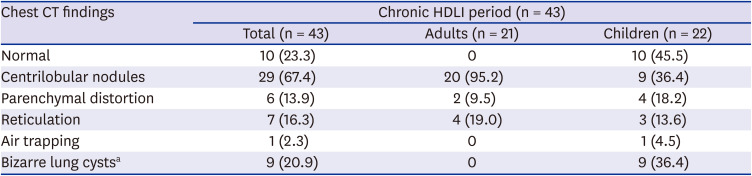
Of the 43 patients, 11 adults and 10 children were hospitalized during acute HDLI period. Ii adults and a kid underwent intensive handling including a mechanical ventilator at the ICU. Their length of stay was ten and 62 days in adults and 54 days in a child. The elapsing of ventilator utilize was 10, 36, and 35 days, respectively. No patients suffered from infectious diseases such as pneumonia during their hospital stay. All 21 patients underwent breast CT during their acute HDLI period. The about common findings in these patients were subpleural sparing (100%), followed by ground-drinking glass opacity (xc.4%) and consolidation (80.9%). Air leak was observed in 9 patients (42.nine%). 1 patient underwent breast tube insertion due to pneumothorax. Interestingly, the incidence of air leak was significantly higher in children than in adults (P = 0.03) (Tables 3 and 4).
Among the 6 categories of chronic CT findings, the most frequent pattern overall was centrilobular nodules (67.four%) (Tables 3 and 4), and this finding was particularly predominant in adults (95.2%). However, 45.v% of children had normal breast CT results, followed by 36.iv% with centrilobular nodules, 36.4% with bizarre lung cysts, and xiii.half dozen% with reticulation. Fisher's exact examination indicated the incidence of baroque lung cysts was significantly greater in children than adults (P = 0.001).
DISCUSSION
The electric current diagnostic criteria for HDLI are highly specific, in that they focus on rapidly progressive and severe lung injury. These criteria were adult to exclude patients whose clinical signs and symptoms may be similar, just not caused past Hard disk exposure. Radiologically, HLDI is characterized by diffuse centrilobular ground-glass opacity and nodules, sparing of subpleural spaces, and often with spontaneous air leaks, such every bit a pneumothorax or pneumomediastinum, but with no testify of air trapping or reticular opacity. There is evidence that the radiologic features of HDLI change over time.78 More than specifically, there are initially areas of patchy consolidation involving the upper lung periphery and posterior lower lung zones, but sparing of the subpleural areas. As illness progressed, spontaneous air leak such as pneumothorax, pneumomediastinum or interstitial emphysema could be occurred.14 Over time, these areas evolve into centrilobular opacities with a gradual disappearance of the consolidation at about v years afterwards cessation of HD exposure.78 Thus, a bronchocentric distribution of nodules is considered the almost characteristic CT characteristic of HDLI in chronic menstruation, and the causative mechanism of bronchocentric injury pattern was an inhalation of Hd.789
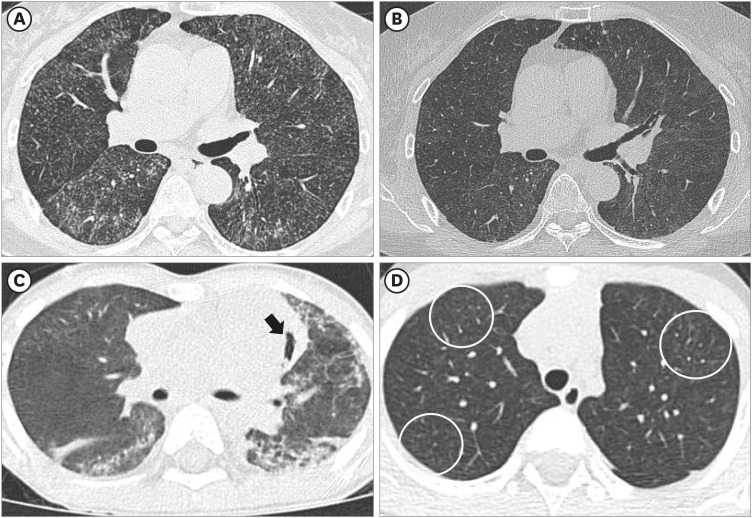
We found that centrilobular nodules were very common (95.2%) in adults with HDLI at an boilerplate of 55 months later abeyance of exposure to Hard disk drive. However, normal radiologic findings were most mutual (45.5%) (Fig. 2), followed by centrilobular nodules in children with HDLI after long term follow-up (36.4%) (Fig. 3). Notwithstanding, Yoon and her colleagues found that centrilobular nodule were the most common finding in chronic HDLI children.viii This discrepancy is probably due to the differences in the average follow-upwardly periods; those in the present study was twice every bit long as those in the previous study. (58.5 months vs. 27.4 months). Furthermore, the lungs of children were still undergoing development. For example, the alveolar ducts of the lungs continue to mature until age 19 months, and microvascular construction matures until about historic period 21 years.15 Thus, the centrilobular nodules in children with HDLI may disappear several years after abeyance of exposure to HD due to their continuing lung development. If this interpretation is correct, then diagnosis of HDLI in children can exist problematic when based on chest CT imaging that is performed several years afterward the cessation of exposure to Hard disk drive.
Fig. 2
Comparison of acute and chronic HDLI image between adult and child patients (family unit No. 3). (A, B) Breast CT of a 50-year-old man with 15 months' Hd exposure. (A) Bilateral ill-divers centrilobular nodules, patchy consolidations with subpleural sparing indicates typical acute HDLI finding. (B) 2 years after Hd exposure cessation. Tiny, ill-defined centrilobular nodules were noted in bilateral lungs (circle). (C, D) Breast CT of a 13-year-old boy with HDLI exposure. (C) Lengthened, ill-defined centrilobular nodules, ground-glass opacity with subpleural sparing and some consolidations involving both lungs. (D) Two years after HD exposure abeyance. Previous findings disappeared and showed normal lung parenchyma.
HDLI = humidifier disinfectant-related lung injury, CT = computed tomography, Hard disk = humidifier disinfectant.
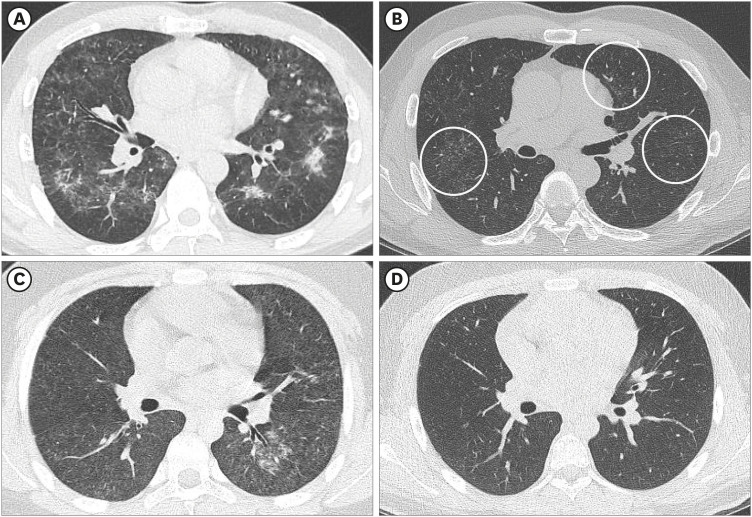
Fig. three
Comparison of acute and chronic HDLI image between adult and kid patients (family No. vii). (A, B) CT of a 63-year-erstwhile adult female with 6 months HD exposure. (A) Bilateral ill-defined centrilobular nodules and ground-glass opacity with subpleural sparing indicates acute to subacute stage HDLI finding. (B) Ii years subsequently Hard disk exposure cessation. Tiny, all-encompassing centrilobular nodules were noted in bilateral lungs. (C, D) CT of a 4-year-former male child with astute HDLI exposure. (C) Bilateral, multifocal consolidations and ground-glass opacity involving both lung parenchyma. Pneumomediastinum also was noted (black pointer). (D) Two years after Hard disk drive exposure cessation. Subtle, subpleural sick-defined centrilobular nodules remained in both upper lobes (circles).
HDLI = humidifier disinfectant-related lung injury, CT = computed tomography, Hard disk = humidifier disinfectant.
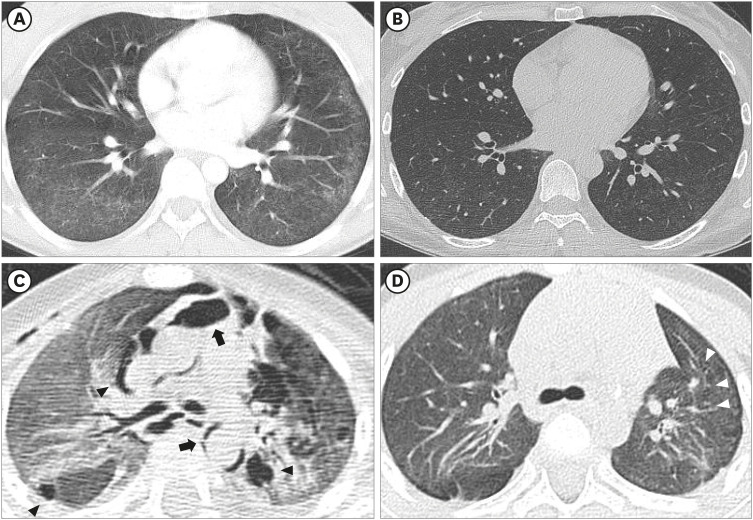
The frequency of baroque lung cysts in long-term follow-upward was significantly greater in children than adults (Figs. 4-7). Our finding that bizarre lung cysts observed in in the long term follow-up, specially in children, could be some other key CT finding to make up one's mind chronic HDLI. Classic lung cyst is one of well-known parenchymal change later on infection, especially bacterial lobar pneumonia or pneumocystis pneumonia. Cystic lung disease such equally Langerhans cell histiocytosis or lymphocytic interstitial pneumonia can present bizarre shaped lung cysts in adults.1617 Yet, those diseases are very rare in babyhood.18 In the nowadays study, baroque lung cysts were more frequently observed in children than adults subsequently cessation of like exposure to Hard disk drive in the same room, even if adults demonstrated chronic, typical centrilobular nodules. Thus, bizarre lung cysts may be useful as some other novel finding of chronic HDLI in children who have no history of pulmonary infection, or other perinatal disorder such as hyaline membrane disease.
Fig. 4
Comparison of acute and chronic HDLI image betwixt developed and child patients (family No. six). (A, B) CT of a 35-year-sometime woman with 4 months Hard disk exposure. (A) Bilateral sick-defined centrilobular nodules, consolidation and subpleural sparing indicates typical acute HDLI finding. (B) Two years later Hd exposure cessation. Tiny, ill-defined centrilobular nodules were noted in the subpleural portion of the bilateral lower lobes (circles). (C, D) CT of a 2-year-old boy with Hard disk drive exposure. (C) Bilateral extensive consolidation and ground-glass opacity involving both lungs. Pneumomediastinum (black arrow) and interstitial emphysema (blackness arrowheads). (D) Two years after HD exposure cessation. Numerous bizarre lung cysts (white arrowheads) are scattered in bilateral lungs.
HDLI = humidifier disinfectant-related lung injury, CT = computed tomography, Hard disk = humidifier disinfectant.
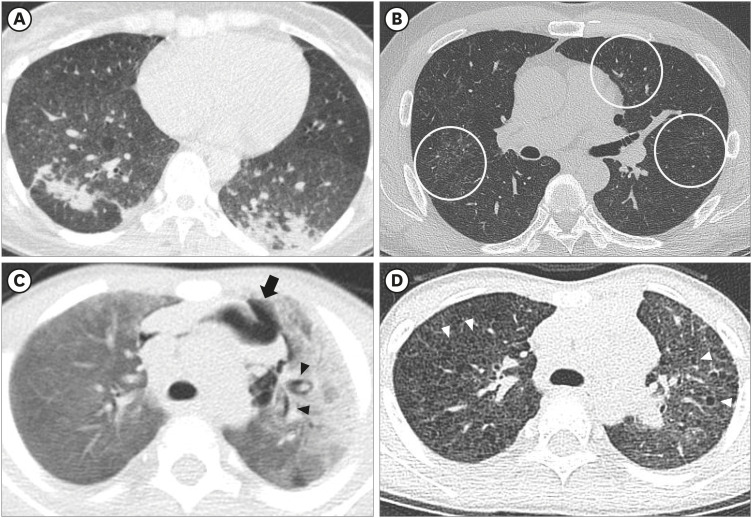
Fig. v
Comparison of astute and chronic HDLI epitome betwixt adult and kid patients (family No. 10). (A, B) CT of a 47-year-old man with 20.three months HD exposure. (A) Bilateral, extensive ground-glass opacity with subpleural sparing and irregular consolidations involving both lungs, indicates astute HDLI finding. (B) Four years subsequently HD exposure cessation. Tiny, all-encompassing centrilobular nodules were noted in bilateral lungs (circles). Due to previous lung damage, parenchymal distortion and bullae developed in the right upper lobe (white pointer). (C, D) CT of a four-year-old boy with HD exposure. (C) Bilateral, all-encompassing ground glass opacity and consolidation involve bilateral lungs. Interstitial emphysema was likewise noted (black arrow). (D) 4 years after HD exposure cessation. Several bizarre lung cysts are noted in bilateral upper lobes (white arrowheads).
HDLI = humidifier disinfectant-related lung injury, CT = computed tomography, Hard disk = humidifier disinfectant.
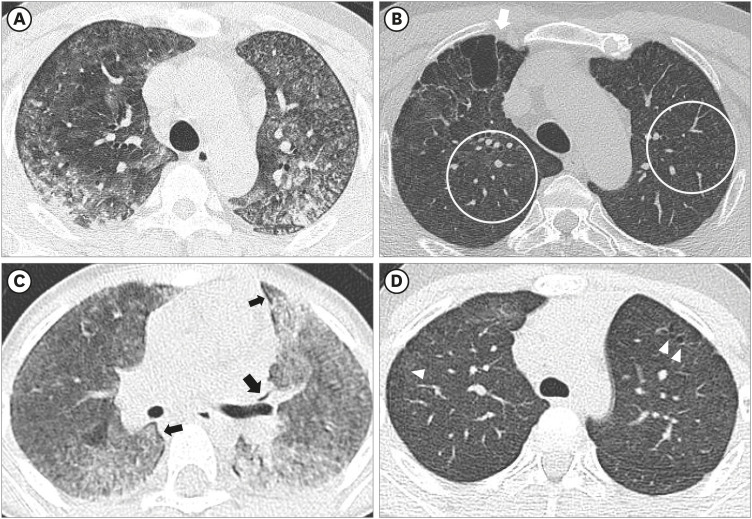
Fig. half-dozen
Comparison of acute and chronic HDLI image between adult and child patients (family No. eleven). (A, B) CT of a 34-year-old woman with ix.8 months HD exposure. (A) Ill-divers centrilobular nodules and some consolidations were noted in bilateral lungs. (B) Three years after HD exposure cessation. Tiny, extensive centrilobular nodules were noted in bilateral lungs. (C, D) CT of a 2-year-old daughter with HD exposure. (C) Bilateral, extensive ground drinking glass opacity and sick-defined centrilobular nodules involve bilateral lungs. Interstitial emphysema was also noted (black pointer). (D) Three years after Hd exposure cessation. Subtle bizarre lung cysts were noted in bilateral upper lobes (white arrowheads).
HDLI = humidifier disinfectant-related lung injury, CT = computed tomography, HD = humidifier disinfectant.
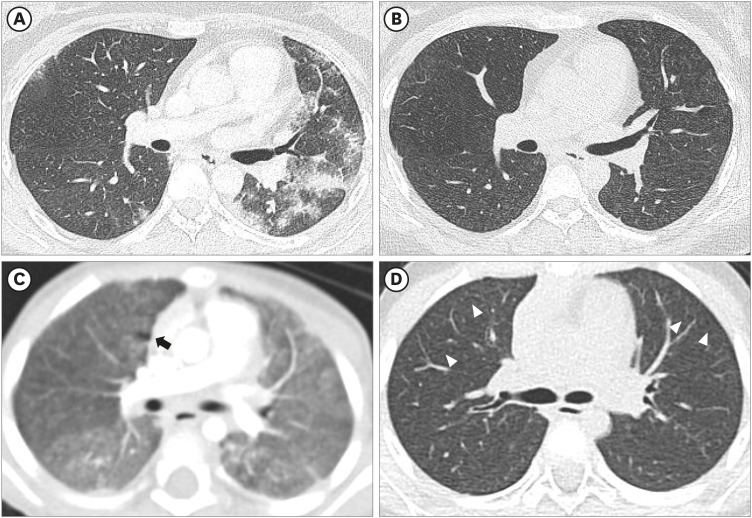
Fig. 7
Comparison of astute and chronic HDLI epitome between adult and child patients (family No. 16). (A, B) CT of a 34-year-sometime adult female with four months' HD exposure. (A) Extensive, ill-divers tiny centrilobular nodules were noted in bilateral lungs, presumed to exist subacute stage of HDLI. (B) Two years subsequently Hard disk exposure cessation. Very tiny centrilobular nodules remain in lung parenchyma. (C, D) CT of a i-yr-sometime male child with HDLI exposure. (C) Bilateral, extensive ground glass opacity and consolidations, indicates acute HDLI finding. Pneumomediastinum (black arrows) and interstitial emphysema (blackness arrowheads) were also constitute. (D) Two years later Hard disk drive exposure cessation. Distortion of bilateral lungs propose postal service-inflammatory parenchymal changes. Subtle bizarre lung cysts were noted in the left upper lobe (white arrowheads).
HDLI = humidifier disinfectant-related lung injury, CT = computed tomography, Hard disk drive = humidifier disinfectant.
We observed reticulation in 4 adults (19.0%) and 3 children (thirteen.six%), and air trapping in an developed and a child. Findings of these patients are not compatible with the current diagnostic criteria of HDLI, which do non include air trapping and reticular opacity. As shown in previous papers, reticulation is considered every bit findings oftentimes shown in other interstitial lung illness such as usual interstitial pneumonia or chronic hypersensitivity pneumonitis (HP) rather than HDLI.3510 However, clinical disorders in which reticulation frequently is observed are rare in children, contrasted with adults, and thus, reticulation are probably due to HDLI. Moreover, familial clustering is seldom identified in other interstitial lung affliction during childhood.14 Thus, abnormal lung lesion such as bizarre lung cysts or reticulation in a suspected child who have history of HD exposure or HD victim in family unit should be considered as late sequelae of HDLI.
Information technology is difficult to distinguish HDLI from HP because sick-divers centrilobular nodules, which are feature findings of subacute HP, resemble those in HDLI.19 In chronic HP cases, breast CT image shows reticulation, traction bronchiectasis, and bronchiolectasis, which mainly involves the subpleural or peribronchovascular region.xx Although pathologic findings and response to corticosteroid therapy are dissimilar for patients with HP and HDLI, subpleural reticulation and traction bronchiectasis may as well be late sequelae of HDLI.359
Air trapping or bronchial wall thickening, the main CT findings of asthma, was rare amid our patients.21 However, a recent study proposed a possibly causal association between exposure to Hard disk and asthma, especially in pediatric patients.22 Thus, the possibility of HDLI should exist considered when asthma-related findings are seen in the CT of a patient who has evidence of pregnant exposure to HD.
The present written report is the first to compare chest CT images of children and adults afterwards cessation of exposure to HD in families with clusters of HDLI, in which family members were exposed to high levels of Hard disk in the same room (homogenous exposure group). Piffling is known virtually differences betwixt children and adults near the long-term natural history of HDLI. Therefore, long-term follow-up of children and adults with HDLI afterwards cessation of exposure to Hard disk volition provide a ground for improved understanding of the natural history of HDLI and the difference between children and adults.
The present study has several clinical implications. Kickoff, based on breast radiology after cessation of exposure to HD, we showed that HDLI may have diverse progression over time. In item, children take a markedly different radiologic course of changes than adults, a finding that should exist considered with other diagnostic radiologic criteria. Thus, the diagnosis of HDLI in children with past exposure to HD appears more challenging.
The present study had several strengths. We examined patients with confirmed HDLI (definite or probable) within the same family who had similar exposures to high levels of Hd in the same surroundings (homogenous exposure group). Familial clustering of HDLI reliably indicates mutual exposure to a high concentration of HD. Thus, we were able to make a direct comparison between adults and children regarding radiologic changes long afterward the abeyance of exposure.
The nowadays study as well had several limitations. Beginning, the number of patients was modest, and we did not apply statistical analysis due to the low statistical ability. A large-scale follow-up imaging written report is needed to examine additional patients recognized in the quaternary circular of this investigation.
2nd, nosotros used family clustering of HDLI as surrogate index of high exposure. Fifty-fifty within the afflicted family unit members, the exposure level may exist different, however, quantitative assessment of exposure level cannot exist ensured because exposure level depended on memory long after exposure, and compensation bug might compound exposure cess. Thus, family clustering of HDLI as surrogate index of loftier exposure seems reasonable although the strength of the exposure could be different even within the family members. Finally, initial imaging was not available in some patients.
In conclusion, we identified several radiologic findings in children and adults with familial clustering of HDLI based on chest CT imaging results from several years after cessation of exposure to HD. Some of these findings differ from the established diagnostic radiologic criteria for HDLI. In particular, the radiologic findings at several years afterward cessation of exposure to Hd were different for children and adults. Our results may serve a basis for an improved understanding of the pathogenesis of HDLI and assistance to better characterize the natural course of this affliction in adults and children.
Notes
References
1. Park D, Leem J, Lee K, Lim H, Choi Y, Ahn JJ, et al. Exposure characteristics of familial cases of lung injury associated with the apply of humidifier disinfectants. Environ Wellness. 2014; 13(ane):70–76. PMID: 25178403.

2. Huh JW, Hong SB, Do KH, Koo HJ, Jang SJ, Lee MS, et al. Inhalation lung injury associated with humidifier disinfectants in adults. J Korean Med Sci. 2016; 31(12):1857–1862. PMID: 27822921.
3. Lee E, Seo JH, Kim HY, Yu J, Jhang WK, Park SJ, et al. Toxic inhalational injury-associated interstitial lung disease in children. J Korean Med Sci. 2013; 28(six):915–923. PMID: 23772158.
4. Lee MS, Kim HJ. Epidemiologic research on lung damage caused by humidifier disinfectants. Epidemiol Wellness. 2016; 38:e2016031. PMID: 27457061.
5. Hong SB, Kim HJ, Huh JW, Exercise KH, Jang SJ, Song JS, et al. A cluster of lung injury associated with abode humidifier use: clinical, radiological and pathological description of a new syndrome. Thorax. 2014; 69(eight):694–702. PMID: 24473332.
6. Kim WY, Hong SB. Humidifier disinfectant-associated lung injury: six years after the tragic event. Tuberc Respir Dis (Seoul). 2017; 80(4):351–357. PMID: 28905528.
7. Koo HJ, Do KH, Chae EJ, Kim HJ, Song JS, Jang SJ, et al. Humidifier disinfectant-associated lung injury in adults: prognostic factors in predicting short-term outcome. Eur Radiol. 2017; 27(ane):203–211. PMID: 27147415.
8. Yoon HM, Lee East, Lee JS, Do KH, Jung AY, Yoon CH, et al. Humidifier disinfectant-associated children's interstitial lung affliction: computed tomographic features, histopathologic correlation and comparing between survivors and not-survivors. Eur Radiol. 2016; 26(1):235–243. PMID: 25991482.
nine. Paek D, Koh Y, Park DU, Cheong HK, Do KH, Lim CM, et al. Nationwide report of humidifier disinfectant lung injury in Due south Korea, 1994–2011. Incidence and dose-response relationships. Ann Am Thorac Soc. 2015; 12(12):1813–1821. PMID: 26653190.
x. Choi JE, Hong SB, Practice KH, Kim HJ, Chung Due south, Lee E, et al. Humidifier disinfectant lung injury, how do we approach the issues? Environ Health Toxicol. 2016; 31:e2016019. PMID: 27608716.
eleven. Ryu SH, Park DU, Lee E, Park Southward, Lee SY, Jung S, et al. Humidifier disinfectant and use characteristics associated with lung injury in Korea. Indoor Air. 2019; 29(5):735–747. PMID: 31278778.
12. Leem JH, Lee JH. Humidifier disinfectant-associated specific diseases should exist called together every bit "humidifier disinfectant syndrome". Environ Health Toxicol. 2017; 32:e2017017. PMID: 29026061.
xiii. Hansell DM, Bankier AA, MacMahon H, McLoud TC, Müller NL, Remy J. Fleischner Gild: glossary of terms for thoracic imaging. Radiology. 2008; 246(3):697–722. PMID: 18195376.
14. Kim KW, Ahn One thousand, Yang HJ, Lee South, Park JD, Kim WK, et al. Humidifier disinfectant-associated children's interstitial lung disease. Am J Respir Crit Care Med. 2014; 189(1):48–56. PMID: 24199596.
fifteen. Schittny JC. Development of the lung. Cell Tissue Res. 2017; 367(3):427–444. PMID: 28144783.
16. Odev Thousand, Guler I, Altinok T, Pekcan S, Batur A, Ozbiner H. Cystic and cavitary lung lesions in children: radiologic findings with pathologic correlation. J Clin Imaging Sci. 2013; 3:60–70. PMID: 24605255.
17. Boddu P, Parimi V, Taddonio M, Kane JR, Yeldandi A. Pathologic and radiologic correlation of adult cystic lung disease: a comprehensive review. Patholog Res Int. 2017; 2017:3502438. PMID: 28270943.
18. Semple TR, Ashworth MT, Owens CM. Interstitial lung affliction in children made easier…well, virtually. Radiographics. 2017; 37(6):1679–1703. PMID: 29019755.
19. Selman M, Pardo A, King TE Jr. Hypersensitivity pneumonitis: insights in diagnosis and pathobiology. Am J Respir Crit Intendance Med. 2012; 186(4):314–324. PMID: 22679012.
20. Spagnolo P, Rossi G, Cavazza A, Bonifazi Grand, Paladini I, Bonella F, et al. Hypersensitivity pneumonitis: a comprehensive review. J Investig Allergol Clin Immunol. 2015; 25(4):237–250.
21. Silva CIS, Colby TV, Müller NL. Asthma and associated conditions: high-resolution CT and pathologic findings. AJR Am J Roentgenol. 2004; 183(three):817–824. PMID: 15333375.
22. Yoon J, Lee SY, Lee SH, Kim EM, Jung S, Cho HJ, et al. Exposure to humidifier disinfectants increases the adventure for asthma in children. Am J Respir Crit Care Med. 2018; 198(12):1583–1586. PMID: 30192634.
Source: https://synapse.koreamed.org/articles/1146220

Post a Comment for "Pathologic and Radiologic Correlation of Adult Cystic Lung Disease- a Comprehensive Review"